
Procurement audit for small and mid-sized companies
A review of current procurement with concrete numbers — what it costs, what it should cost, and where the biggest opportunities are.
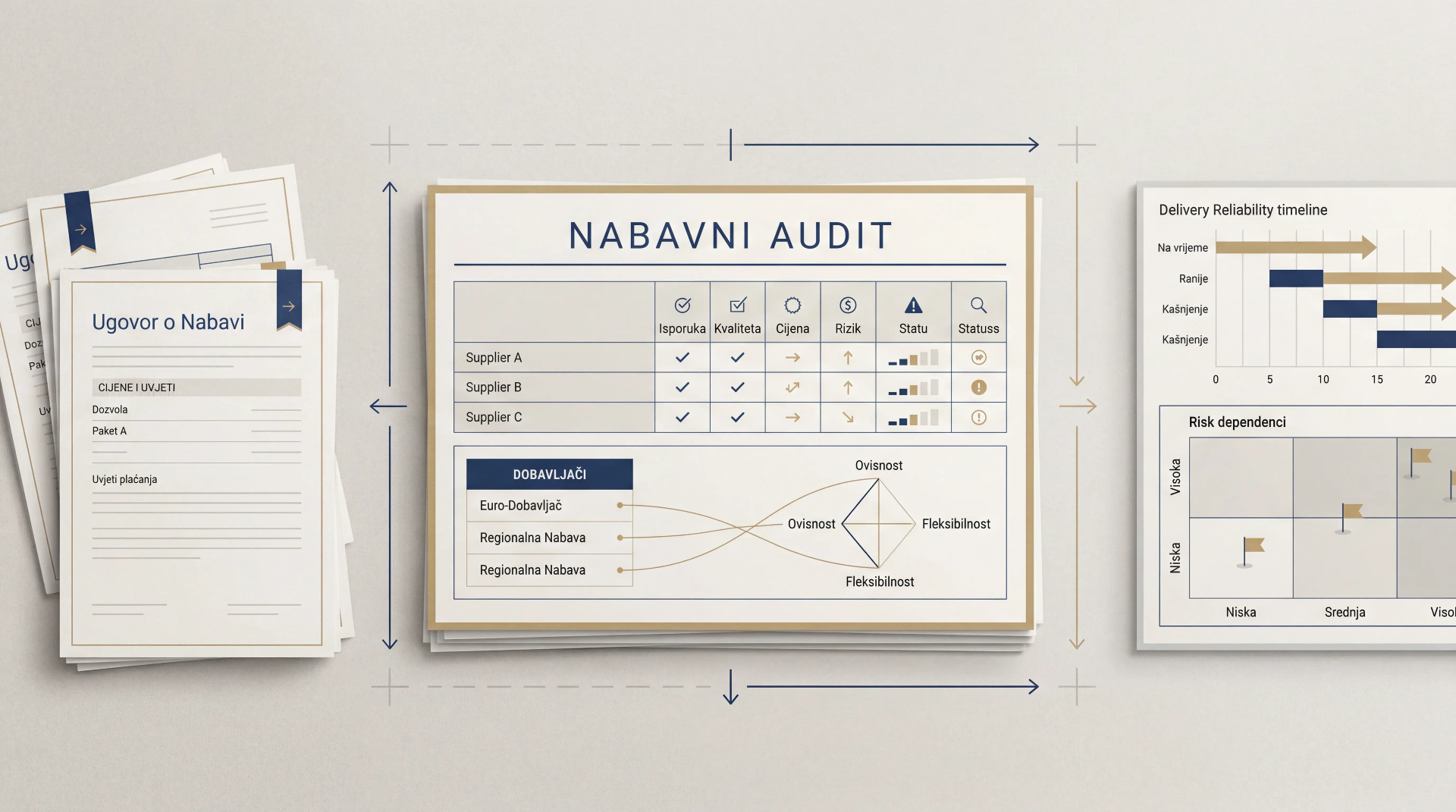
Most companies don't precisely know how much they spend, on what, or with whom. A procurement audit quickly produces the real picture — top categories, risk concentrations and concrete savings opportunities — without splitting hairs on immaterial items. The approach is shaped by retail procurement work, where spend visibility and purchasing discipline are the foundation of every decision.
What changes after we work together
- Scattered spend data with no view by category.
- Suppliers without segmentation by criticality.
- Unclear real cost and hidden margins.
- Spend visibility by category, supplier and impact.
- Prioritized savings opportunities with potential estimates.
- Clear risks and concrete first moves to execute.
When this service makes sense
- Companies whose procurement grows but isn't structured.
- Owners who suspect they overpay but lack comparison data.
- Companies entering growth and wanting to clean procurement before scaling.
- You've never systematically reviewed total procurement.
- Costs grow faster than revenue and you don't know where.
- You are preparing for growth or investment and need a clear cost base.
What gets reviewed in a procurement audit
The goal is not to grade the team — it is to expose hidden reserves and risks. The review covers the whole chain from suppliers to the internal ordering process.
- Suppliers
Structure, concentration and quality of the current base.
- Prices
Price level vs. market and internal benchmarks.
- Payment terms
Deadlines, currencies, discounts and cash-flow impact.
- Contracts
What is actually written, what is applied, where the gaps are.
- Lead times
Reliability and real deviation from agreed delivery.
- Supplier dependency
Who would 'shut down' the business if they disappeared tomorrow.
- Inventory
Levels, turnover, obsolete and dead stock positions.
- MOQs
Minimum orders that create unnecessary stock.
- Complaints
Frequency, cost and who actually bears it.
- Internal ordering process
Who decides, who approves and how fast.
How we work
Data collection
Procurement data analysis from accounting and ERP for the last 12 months.
Spend segmentation
Categorization by type, supplier and business impact.
Opportunity identification
A map of concrete savings opportunities with potential estimates.
Data collection
Procurement data analysis from accounting and ERP for the last 12 months.
Spend segmentation
Categorization by type, supplier and business impact.
Opportunity identification
A map of concrete savings opportunities with potential estimates.
Concrete outcomes
- Written procurement status report.
- Spend segmentation by category, supplier and criticality.
- Prioritized opportunity list with estimated impact.
Procurement audit
- 01Supplier overview
- 02Procurement terms
- 03Cost opportunities
- 04Supply risks
- 05Negotiation priorities
- 06Savings plan
Let's see where your procurement really stands
Send the data, receive a structured picture within a few weeks. No obligation.
The first conversation is informative and without obligation.
Questions clients most often ask before we start working together.